
Contact Us:
House 3, Gloriana Gardens Estate, NUT road, Sabon Lugbe, Abuja, Nigeria
Landmark: National Union of Teachers (NUT), Sabon Lugbe.
Tel: +2349070051404
Email: info@famefoundationwg.org
A Not-Profitable Organisation set up to formulate programmes through several initiatives to mentor, empower and advocate for women and girls.
FAME foundation was established to solicit, encourage and advance the social, emotional and economic wellbeing of women and girls as well as formulate programmes within the framework of national development plan with a view to enhancing the participation of women and advocate for gender parity in the society. FAME foundation firmly believe that the entire nation, businesses, communities and groups can benefit from the implementation of programs and policies that adopt the notion of women empowerment.
 August 12, 2026
South Africa and China are set to deepen cooperation on disability inclusion, data, universal design, artificial intelligence and assistive technology as the two countries seek practical ways to improve the lives and rights of persons with disabilities.
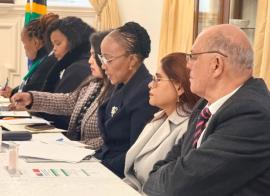
The commitment was highlighted by the Minister in the Presidency responsible for Women, Youth and Persons with Disabilities Sindisiwe Chikunga during the visit of a delegation from the China Disabled Persons’ Federation (CDPF) to South Africa on Tuesday.
Welcoming the Chinese delegation, the Minister described the engagement as an important continuation of high-level discussions held in China in October 2025, saying the two countries were now moving from dialogue towards measurable and practical implementation.
The partnership is grounded in the United Nations Convention on the Rights of Persons with Disabilities and South Africa’s White Paper on the Rights of Persons with Disabilities.
The Minister stressed that disability inclusion should not be treated as a stand-alone programme, but must be integrated across government planning, budgeting and digital transformation.
At the heart of the cooperation is a commitment to ensuring that persons with disabilities are recognised not merely as recipients of services, but as rights-holders, economic contributors, innovators and equal citizens.
Using data to drive inclusion
Chikunga said effective planning for inclusion requires governments to understand who is being excluded, where barriers exist and whether policies are producing meaningful results.
South Africa is therefore conceptualising a Disability Nerve Centre of Excellence as a G20 legacy project. The proposed centre would work with Statistics South Africa, institutions of higher learning and other disability-data stakeholders.
South Africa also wants to exchange expertise with China on disability-disaggregated administrative data, census methodologies, digital platforms and the ethical use of data.
Universal design was identified as another major pillar of the proposed partnership.
The Minister said accessibility should become a normal and non-negotiable part of national development rather than something added after infrastructure and services have already been designed.
This includes public buildings, transport networks, housing and digital platforms.
South Africa and China could also collaborate on joint training and knowledge exchanges on universal design and compliance auditing. Such programmes could benefit government officials, architects, urban planners and information technology professionals.
The Minister called for the two countries to explore ethical, affordable and locally relevant AI-enabled assistive technologies.
The proposed areas of cooperation include smart wheelchairs and intelligent mobility devices, AI-supported speech-to-text and text-to-speech tools, communication technologies, navigation systems for blind and visually impaired people, accessible digital interfaces, AI-supported learning tools, rehabilitation technologies and smart-home solutions.
However, Chikunga cautioned that innovation must be accessible to the people who need it most.
The goal, she said, is to combine innovation with inclusion, technology with dignity and artificial intelligence with human rights.
The Minister noted that people cannot fully access government services, education, employment, justice or healthcare if information is not provided in a form they can understand and use.
The proposed approach includes Easy Read and plain-language communication, Braille and accessible print, captioning and subtitling, South African Sign Language and other sign-language services, audio descriptions, accessible websites and mobile applications, as well as targeted accessible public information campaigns.
The Minister proposed a seven-point action plan designed to ensure that the bilateral engagement produces tangible outcomes rather than simply more meetings and presentations.
The proposed framework includes establishing a South Africa–China Disability Inclusion Knowledge Exchange Platform, joint capacity-building programmes, stronger cooperation between research institutions and universities, collaboration with technology developers and organisations of persons with disabilities, joint exploration of AI and assistive technologies, deeper cooperation on disability data and statistics, and joint programmes on universal design and accessibility.
The plan also proposes structured exchanges between learners with disabilities in pre-vocational and vocational programmes in both countries to support skills development. – SAnews.gov.za
Source: SA news