
Contact Us:
House 3, Gloriana Gardens Estate, NUT road, Sabon Lugbe, Abuja, Nigeria
Landmark: National Union of Teachers (NUT), Sabon Lugbe.
Tel: +2349070051404
Email: info@famefoundationwg.org
A Not-Profitable Organisation set up to formulate programmes through several initiatives to mentor, empower and advocate for women and girls.
FAME foundation was established to solicit, encourage and advance the social, emotional and economic wellbeing of women and girls as well as formulate programmes within the framework of national development plan with a view to enhancing the participation of women and advocate for gender parity in the society. FAME foundation firmly believe that the entire nation, businesses, communities and groups can benefit from the implementation of programs and policies that adopt the notion of women empowerment.
 July 3, 2026
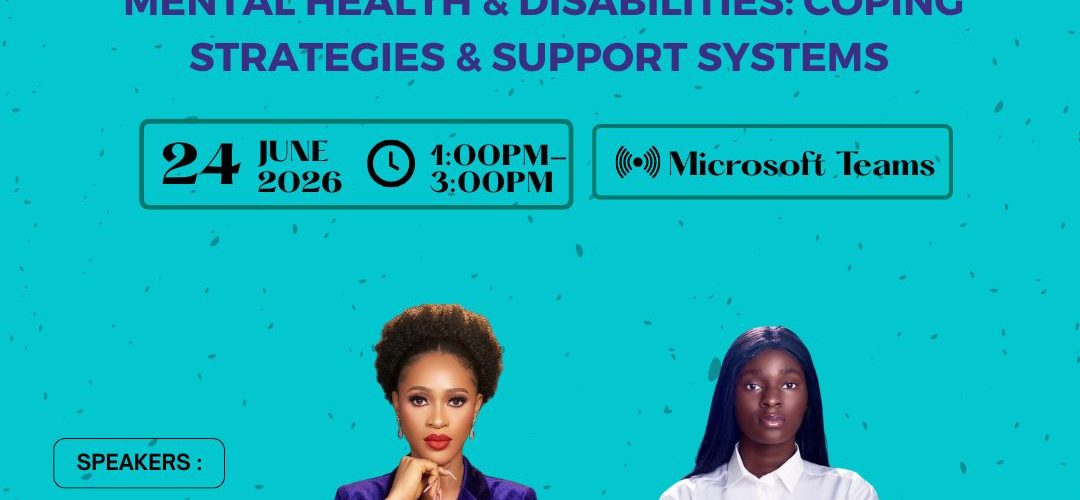
HerSTEM Initiative, a program of FAME Foundation, organized its monthly webinar, titled “Mental Health & Disabilities: Coping Strategies & Support Systems,” on June 24, 2026. The session was held on Microsoft Teams. It provided a framework for understanding the unique mental health challenges faced by persons with disabilities and equipping participants with practical, evidence-based tools to build resilience and strong support networks. The webinar aimed to empower attendees, including persons with disabilities, caregivers, mental health professionals, educators, and advocates, with actionable strategies to protect mental well-being and foster genuine inclusion.
The webinar featured a discussion led by host Muhammed Opaluwa, Program Manager for the HerSTEM initiative, and guest speakers Meek Ekpo, a Disability Inclusion Advocate, Nigerian Sign Language Interpreter, and author of “How to Make Inclusion Practical,” and Damilola Akanni, a passionate advocate for Education, Gender Equality, and Youth Development who has reached over 5,000 girls across Nigeria through empowerment and SGBV prevention initiatives. The session challenged the misconception that mental health struggles for persons with disabilities are personal failings, framing them instead as responses to structural barriers, social isolation, and systemic exclusion.
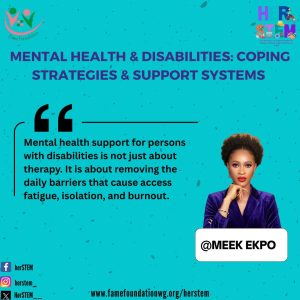
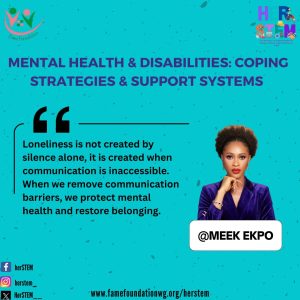
A central theme was the unique mental health landscape faced by persons with disabilities. The host introduced key stressors including access fatigue, the constant mental energy spent navigating inaccessible environments, social isolation, internalized ableism, and medical trauma. Meek Ekpo emphasized that “loneliness is not created by silence alone; it is created when communication is inaccessible,” and highlighted that without support equipment or sign language interpreters, hearing-impaired students experience what she termed “structural loneliness,” leading to anxiety, hypervigilance, and academic underperformance. She stressed that “mental health support for persons with disabilities is not just about therapy; it is about removing the daily barriers that cause access fatigue, isolation, and burnout.” Damilola Akanni added that girls with disabilities face unique challenges including anxiety, discrimination, and dependency, noting that “these are not weaknesses, they are responses to a world that often excludes them.”
The discussion provided practical coping strategies for everyday mental well-being. The host introduced the Energy Accounting Framework, viewing energy as a bank account where activities have costs and rest is a deposit, alongside micro-boundaries, sensory regulation tools, and meaningful daily rituals. Damilola Akanni reframed resilience, stating, “Resilience is not about pretending that girls with disabilities don’t face challenges. It is about giving them the confidence, support, and opportunities to overcome and thrive.” She emphasized that “every girl with a disability deserves the confidence to believe that her abilities are greater than the barriers placed before her.” Meek Ekpo added that “inclusion begins with connection,” explaining that when schools teach sign language and communities foster meaningful peer relationships, children with disabilities gain “friendship, confidence, and a true sense of belonging.”
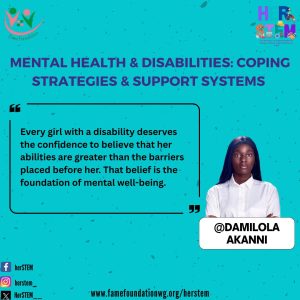
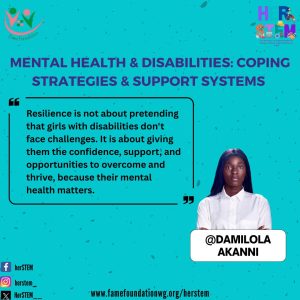
The conversation also addressed building strong support systems, introducing the Circle Model of support, inner, middle, and outer circles, and the concept of a Communication Card to simplify advocacy. Meek Ekpo stated, “Inclusion must be taught early. When children learn about disability from a young age, they grow up knowing how to support and befriend students with disabilities naturally.” Damilola Akanni called on educators and caregivers to be intentional, saying, “Teachers must create safe spaces for girls with disabilities. A little patience and understanding can make the difference between a child who withdraws and a child who thrives.” On self-advocacy, she added, “When we empower girls with disabilities with confidence, inclusion, and opportunity, we don’t just change their lives; we change the future of our communities.”
The session concluded with a consensus that mental health support for persons with disabilities requires intentional, ongoing effort from individuals, communities, and institutions. Key takeaways included acknowledging that mental health struggles are often responses to barriers, not personal failings; adopting practical coping tools like energy accounting and micro-boundaries; building strong circles of support; and seeking professional help when needed. Meek Ekpo summarized the goal: “When we remove communication barriers, we protect mental health and restore belonging.” Damilola Akanni echoed this, stating, “Resilience is not pretending challenges don’t exist; it is equipping children with disabilities with the skills, support, and belief they need to navigate and overcome those challenges.” The webinar empowered participants to identify one coping strategy to try, share what they have learnt with others, and practice self-compassion as they continue their journey toward mental well-being.