A Not-Profitable Organisation set up to formulate programmes through several initiatives to mentor, empower and advocate for women and girls.
FAME foundation was established to solicit, encourage and advance the social, emotional and economic wellbeing of women and girls as well as formulate programmes within the framework of national development plan with a view to enhancing the participation of women and advocate for gender parity in the society. FAME foundation firmly believe that the entire nation, businesses, communities and groups can benefit from the implementation of programs and policies that adopt the notion of women empowerment.


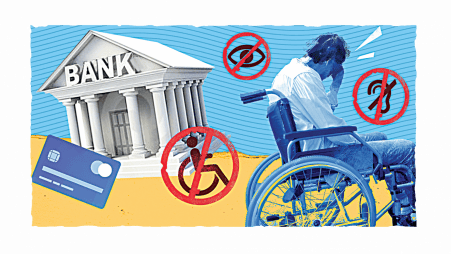
A wheelchair user walks into a Dhaka bank branch to withdraw cash, only to turn back because the counter is too high. A woman with visual impairment cannot use her bank’s mobile app because it is incompatible with screen readers. A businessman with hearing impairment struggles to communicate with a loan officer.
These are not isolated incidents. They reflect the barriers that keep millions of persons with disabilities outside the mainstream financial system.
Under the UN Convention on the Rights of Persons with Disabilities, disability arises not only from physical, mental, intellectual or sensory impairments, but also from the barriers society creates. Anyone can become disabled through birth, illness, accident or ageing, making accessibility an issue that can affect every family.
Financial inclusion is central to economic inclusion. Without access to banking, credit and digital financial services, people with disabilities face greater barriers to employment, entrepreneurship, saving and investment. The ILO estimates that excluding persons with disabilities from the labour market can cost countries 3–7% of GDP, with losses tending to be higher in low- and middle-income countries.
Bangladesh has an estimated 38.4 lakh registered persons with disabilities according to recent government data. Persons with disabilities are therefore not simply a group in need of support. They are a vast population of workers, entrepreneurs and consumers whose economic potential remains largely untapped.
Lessons from other countries
The World Bank’s Global Findex 2025 shows that 79% of adults worldwide now have a financial account. Yet it does not disaggregate data by disability status, leaving policymakers with little insight into their financial inclusion.
A study in Kenya found that low education, unemployment and low income make persons with disabilities two to three times more likely to be excluded from financial services. Financial literacy is also a challenge, as people with visual or hearing impairments are often left out of conventional learning materials.
South Asia has made significant progress in financial inclusion, with adult account ownership reaching around 78%. But persons with disabilities have not benefited equally. Across Asia-Pacific, the rapid growth of digital banking has often created new barriers because accessibility was not built into mobile apps, ATMs and QR payment systems.
Other countries offer useful lessons. India has required banks since 2009 to provide ramps and talking ATMs with Braille keypads. In April 2025, its Supreme Court ruled in Pragya Prasun v. Union of India that digital access to financial services is a fundamental right under Article 21.
Union Bank of India’s “Union Access” initiative combines Braille debit cards, screen-reader-friendly digital banking and staff training. In Kenya, a pilot involving seven major banks assessed and improved accessibility with support from the Kenya Bankers Association, FSD Kenya and inABLE.
These examples show that disability-inclusive banking is possible when accessibility is treated as a requirement rather than an afterthought.
When the numbers do not add up
In Bangladesh, confusion over the actual number of persons with disabilities is itself a policy crisis. The 2011 census put the rate at around 1.4%; a 2010 Household Income and Expenditure Survey found over 9% — and even the government’s own surveys since have disagreed sharply with each other.
The Bangladesh Bureau of Statistics’ National Survey on Persons with Disabilities (NSPD) 2021 puts it at 2.8%, or roughly 4.6 million people, while its own 2022 Household Income and Expenditure Survey found nearly double that, 5.71%, or about 9.4 million. As of October 2024, the Department of Social Services’ registry listed only 3.4 million. Depending on methodology, then, the estimate swings by several million people in the same country, at roughly the same time.
Applying the WHO’s global average of 16% to Bangladesh’s population would suggest around 27 million people — while the country’s own surveys show only 4.6 to 9.4 million.
Much of this gap traces back to how the question is asked: a direct question — “Are you disabled?” — invites under-reporting due to social stigma, while the internationally recognised, functioning-based Washington Group method tends to yield significantly higher numbers.
Disaggregated data by type of disability, though still limited, matters too. NSPD 2021 found physical disability most prevalent at 1.35%, followed by visual (0.46%), hearing (0.36%), multiple disabilities (0.35%), speech (0.32%) and intellectual disability (0.22%).
This breakdown matters because a visually impaired customer needs Braille services, while a customer with hearing and speech impairment needs sign-language services — entirely different needs that get lost when everyone is grouped under one umbrella. The number of mobility- or wheelchair-dependent users is also still not clearly captured in national surveys, a significant gap for branch-infrastructure planning.
Policy gaps and promising initiatives
For a person with a disability, a bank account is more than a transaction tool. It means dignity, independence and economic security. Without an account in their own name, they can be excluded from government allowances, remittances, microcredit and entrepreneurship, while dependence on family members can increase the risk of exploitation.
The poverty-reduction targets of the National Social Security Strategy and the Eighth Five-Year Plan cannot be achieved without the financial inclusion of persons with disabilities.
First, the central bank must issue specific financial inclusion guidelines for persons with disabilities, making accessibility standards mandatory for branch infrastructure, digital platforms and KYC processes.
The core problem is not a lack of policy but weak implementation. Bank branches and ATMs remain largely inaccessible to wheelchair users, while many mobile and internet banking apps are incompatible with screen readers or voice guidance. KYC requirements involving signatures or photographs can also create barriers.
Without proper training, bank staff may assume that people with disabilities cannot make financial decisions, undermining their legal rights. The lack of disability-disaggregated data further limits effective policymaking.
Bangladesh’s Rights and Protection of Persons with Disabilities Act 2013 recognises their right to property, credit and financial services. Disability allowances through mobile financial services are also a step towards greater inclusion.
Some banks are beginning to act. In May 2025, Prime Bank, Monash University Australia and Team Inclusion Bangladesh held a three-day training on inclusive banking for senior banking professionals. Under its “From Access to Empowerment” approach, Prime Bank has also introduced Braille financial literacy materials, worked to issue chequebooks and debit cards in customers’ own names, and launched sign-language WhatsApp video banking for customers with hearing and speech impairments. Some branches have also lowered cash-counter heights for wheelchair users.
Such efforts are promising, but they remain limited to individual institutions. The next step is to turn these practices into sector-wide standards.
What needs to be done
No single institution can solve a problem of this scale; it needs coordinated action.
First, the central bank must issue specific financial inclusion guidelines for persons with disabilities, making accessibility standards mandatory for branch infrastructure, digital platforms and KYC processes.
Second, banks and mobile financial service providers must upgrade their apps and websites to international accessibility standards.
Third, disability-sensitisation training should be made mandatory for bank staff at every level.
Fourth, financial literacy programmes must include Braille materials, and sign language should be used in all public video communication by banks and financial institutions.
Fifth, disability must be added as a distinct category in regular data collection, with disaggregated figures published by type, so progress can be measured.
Sixth, government-led or government-incentivised institutions should be built to develop the skills and financial independence of persons with disabilities and children with special needs, with every educational institution ensuring appropriate access and environment for their learning.
Ultimately, financial inclusion of persons with disabilities is not a charity programme — it is a precondition for equity and development economics. Any talk of “full financial inclusion” that excludes roughly 1.3 billion people worldwide, and several million in Bangladesh, is an incomplete goal.
Policymakers, the central bank, commercial banks and fintech companies must decide, now, that disability is no longer the exception but the centre of inclusive financial design.
That journey will find its true meaning on the day a wheelchair user can walk into a bank and receive service without obstruction, a customer with hearing and speech impairment can bank independently in their own language, and a visually impaired woman can manage her savings through mobile banking without hindrance.
Source: THE BUSINESS STANDARD
House 3, Gloriana Gardens Estate, NUT road, Sabon Lugbe, Abuja, Nigeria
Landmark: National Union of Teachers (NUT), Sabon Lugbe.
Tel: +2349070051404
Email: info@famefoundationwg.org