
Contact Us:
House 3, Gloriana Gardens Estate, NUT road, Sabon Lugbe, Abuja, Nigeria
Landmark: National Union of Teachers (NUT), Sabon Lugbe.
Tel: +2349070051404
Email: info@famefoundationwg.org
A Not-Profitable Organisation set up to formulate programmes through several initiatives to mentor, empower and advocate for women and girls.
FAME foundation was established to solicit, encourage and advance the social, emotional and economic wellbeing of women and girls as well as formulate programmes within the framework of national development plan with a view to enhancing the participation of women and advocate for gender parity in the society. FAME foundation firmly believe that the entire nation, businesses, communities and groups can benefit from the implementation of programs and policies that adopt the notion of women empowerment.
 May 7, 2026
HerSTEM Initiative, a program of FAME Foundation, organized its monthly webinar, titled “Universal Design: Making Public Spaces Accessible for Everyone,” on April 29, 2026. The session was held on Microsoft Teams. It provided a framework for moving beyond reactive retrofitting to proactive, inclusive design that benefits all community members. The webinar aimed to equip participants—including architects, city planners, business owners, advocates, and students—with practical strategies to create public spaces that are welcoming, dignified, and functional for everyone, regardless of age, size, or ability.
The webinar featured a discussion led by host Muhammed Opaluwa, Program Manager for HerSTEM, and guest speakers Deborah Adesanya, a development practitioner and Gender Equality, Disability, and Social Inclusion (GEDSI) specialist, and Victoria Ogunjobi, a special educator and Certified Autism Specialist. The session challenged the notion of accessibility as an afterthought, framing universal design as a fundamental pillar of an equitable society and a smart economic investment.
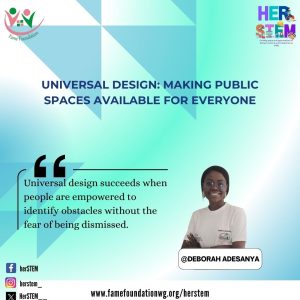
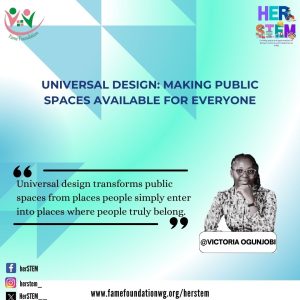
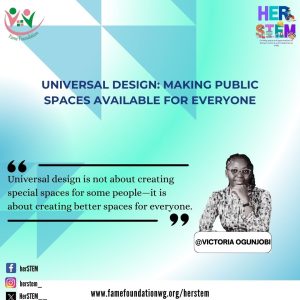
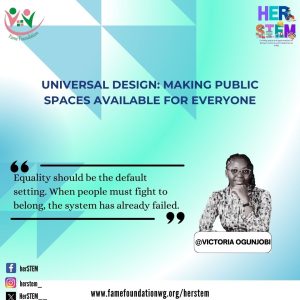
A central theme was the philosophy of universal design, moving from retrofitting spaces for some to designing for all from the very beginning. Muhammed Opaluwa introduced the seven core principles, highlighting equitable use, simple and intuitive design, and low physical effort. He emphasized that ignoring these principles excludes a significant portion of the population. Victoria Ogunjobi reinforced this by stating, “Universal design is not about creating special spaces for some people; it is about creating better spaces for everyone,” and added that “equality should be the default setting. When people must fight to belong, the system has already failed.” The discussion grounded universal design as a human right, not a charitable add-on.
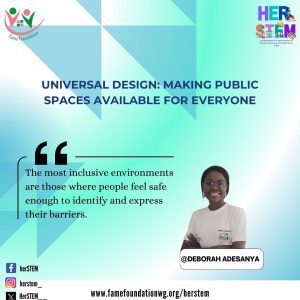
The discussion addressed the practical application of universal design beyond the ramp, covering wayfinding, seating, sensory considerations, and digital access. Strategies included tactile paving, auditory pedestrian signals, varied seating options, quiet zones, and accessible digital information. Victoria Ogunjobi noted overlooked aspects of sensory inclusivity, stating, “The biggest barriers are not stairs or doors, but attitudes that refuse to make room for others.” She called for designing spaces that do not overwhelm people with autism or sensory sensitivities, emphasizing that “clear pathways create more than movement; they create freedom, confidence, and independence.” Deborah Adesanya added that “the most inclusive environments are those where people feel safe enough to identify and express their barriers,” stressing that genuine collaboration with persons with disabilities is non-negotiable.
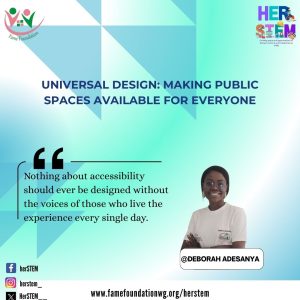
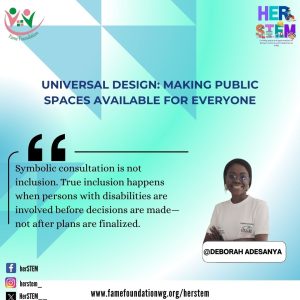
On the economic and social case for universal design, the speakers countered the misconception that accessibility is too expensive. Muhammed Opaluwa explained that retrofitting almost always costs more than designing inclusively from the start, and that universal design expands user bases, future-proofs spaces for an aging population, and strengthens social cohesion. Deborah Adesanya stated, “Symbolic consultation is not inclusion. True inclusion happens when persons with disabilities are involved before decisions are made, not after plans are finalized.” She introduced the concept of “neo-inclusion,” moving beyond appearance to genuine participation where every voice influences decisions. On low-cost, high-impact changes, she advocated for building trust through “self-availability,” so people feel empowered to identify barriers.
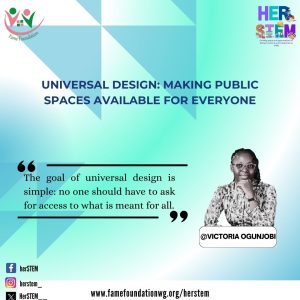
The session concluded with a consensus that universal design is an intentional, ongoing practice requiring collaboration and persistence. Key takeaways included designing with the principles of equity, simplicity, and low physical effort; thinking holistically about the entire user experience; and centering the mantra “Nothing about us without us.” Victoria Ogunjobi summarized the goal: “The goal of universal design is simple: no one should have to ask for access to what was meant for all.” Deborah Adesanya echoed this, stating, “True accessibility is created through collaboration, not assumptions,” and added that “an inclusive society is built when consultation becomes collaboration and participation becomes power.” The webinar empowered participants to commit to one actionable change, become advocates in their communities, and amplify the voices of people with disabilities in all design processes.